
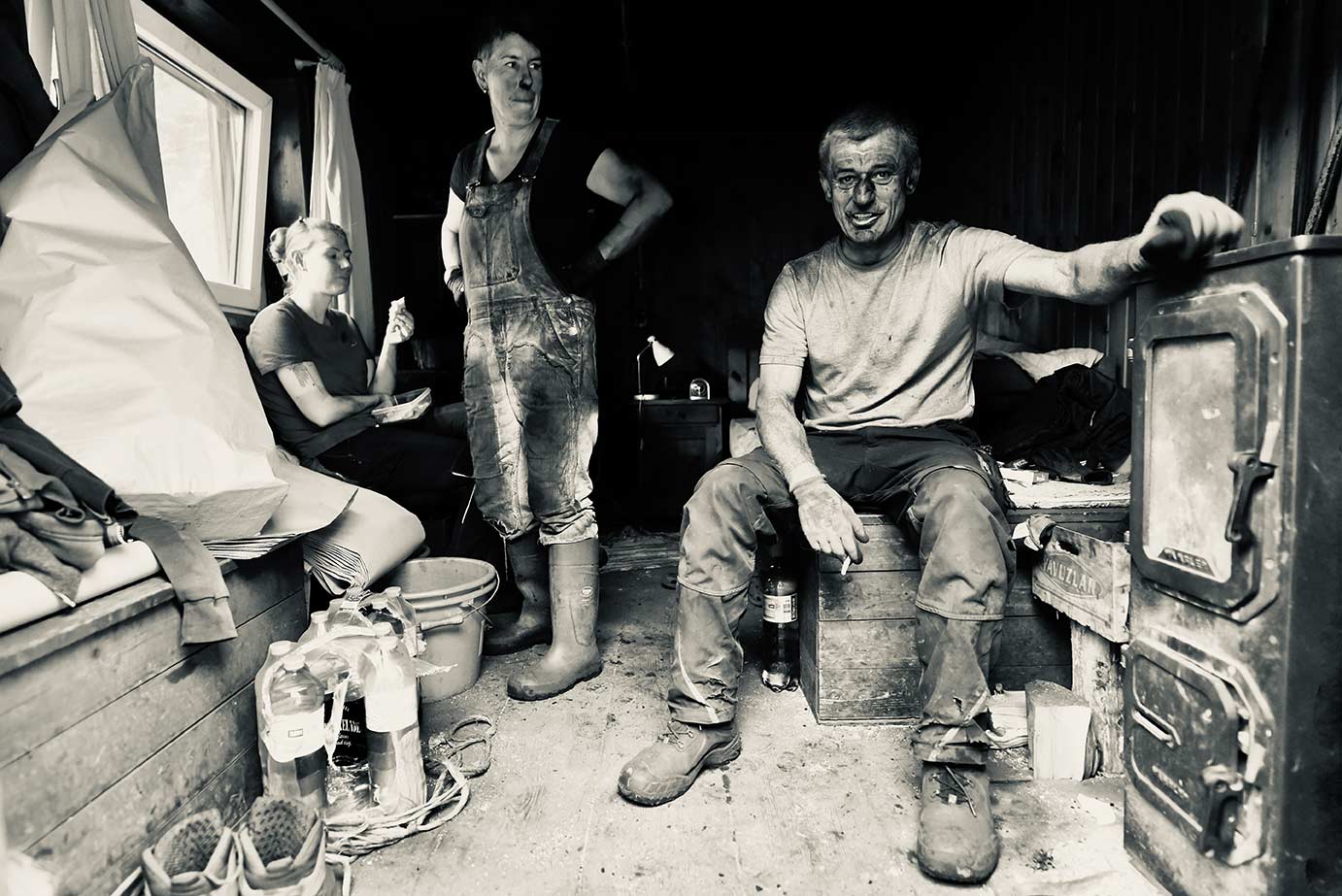
The Charcoal Brothers and their Wives
By Holger Hoffmann
Holger Hoffmann ©
All rights reserved.
Once upon a time, there were … two brothers, Peter and Sepp, living in the mountains, or more precisely in Rohr im Gebirge, a village of 425 souls in Lower Austria. Both are married to women that any farmer could only dream of, and have grown-up children who assist with charcoal burning.
As charcoal enthusiasts, we were drawn to Rohr im Gebirge because we wanted to see with our own eyes that it is no fairy tale that the world’s last ‘long kilns’ are operated here during the summer months, two of them by Peter and Sepp Wieser. When we arrive at Sepp’s farm, customers are loading their delivery truck with 16kg bags of charcoal. Regina, Sepp’s wife, laughs as she takes two under each arm. The welcome is warm. Tomorrow morning, they will clear out their kiln.
Holger Hoffmann ©
All rights reserved.
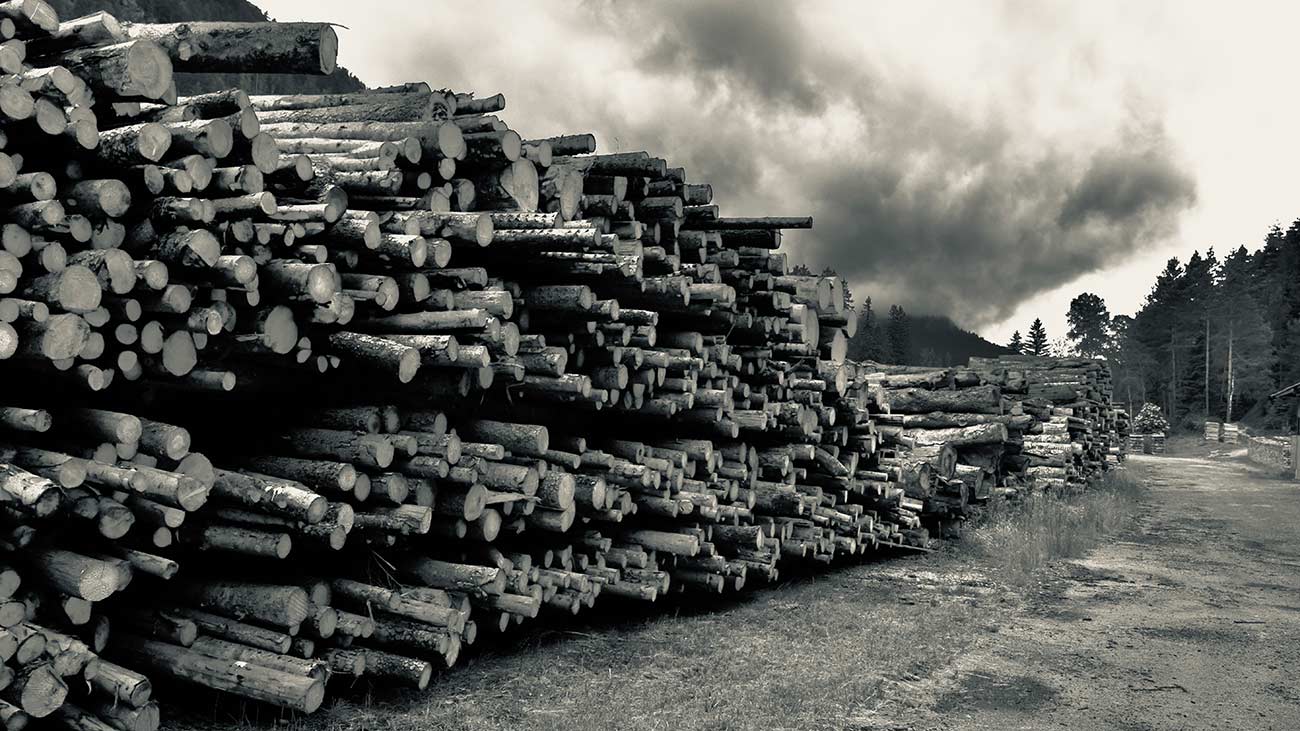
We spend the evening with Peter and Gertrud. They tell us that Peter’s father taught both sons how to burn charcoal. Sepp, the younger son, took over his parents’ farm, and in 1994, Peter and Gertrud built their own farm. They have around 120 hectares of land, 20 hectares of which is pastureland with Highland cattle, and the rest is forest. This distribution is typical for the more than 40 farms in Rohr im Gebirge. The focus is on forestry. From 115 hectares upwards, farmers also have a hunting license. Peter and his brother’s farm are among the smaller ones.
Burning charcoal is a welcome source of additional income. Both burn three to four kilns per year. The demand for charcoal is high, and its quality is appreciated.
Gertrud and Peter willingly answer all our questions about the long kiln’s special features, fetch books, give us two brochures written by Gertrud, and tell us about their commitment when they were still on the board of the European Charcoal Burners Association. At that time, they suggested including charcoal burning in Austria in the UNESCO national register of intangible cultural heritage as a traditional craft in 2011.
Holger Hoffmann ©
All rights reserved.
We spend the night in our camper right next to Gertrud and Peter’s smoldering kiln, the unmistakable smell of charcoal in our noses.
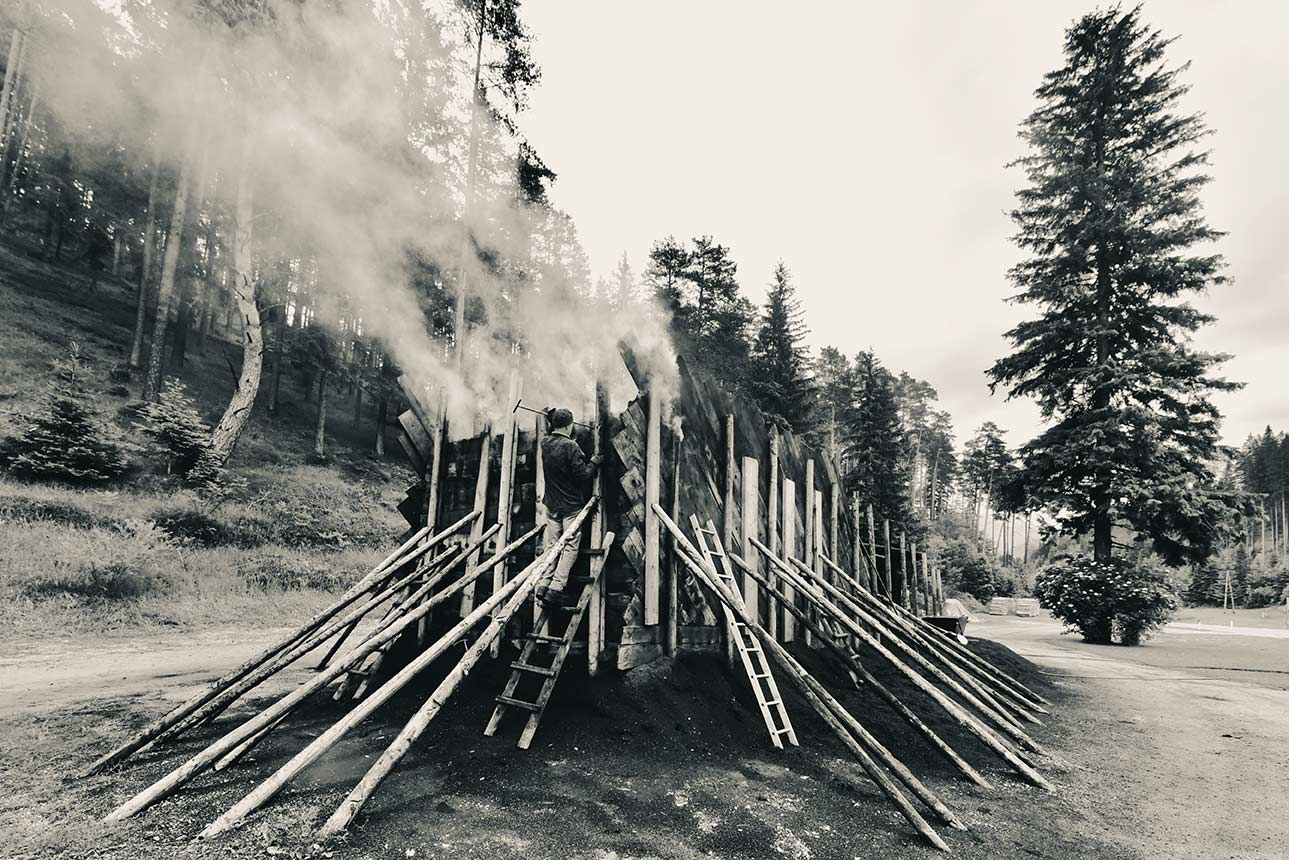
As promised, Peter knocks on our door at 6 a.m. He is making his daily morning round. He uses a “tapping iron” to poke into the side air holes one by one to feel if he’s hitting charcoal yet and to check the color of the smoke coming out. If he still hits wood, he opens more air holes to speed up the charring process. Peter also observes the insulating layer. Where the charring process is complete, the layer is dry and light gray. Peter is satisfied, and we head over to Sepp and Regina’s kiln to see how they’re getting on with the extraction.
Holger Hoffmann ©
All rights reserved.
Long kiln
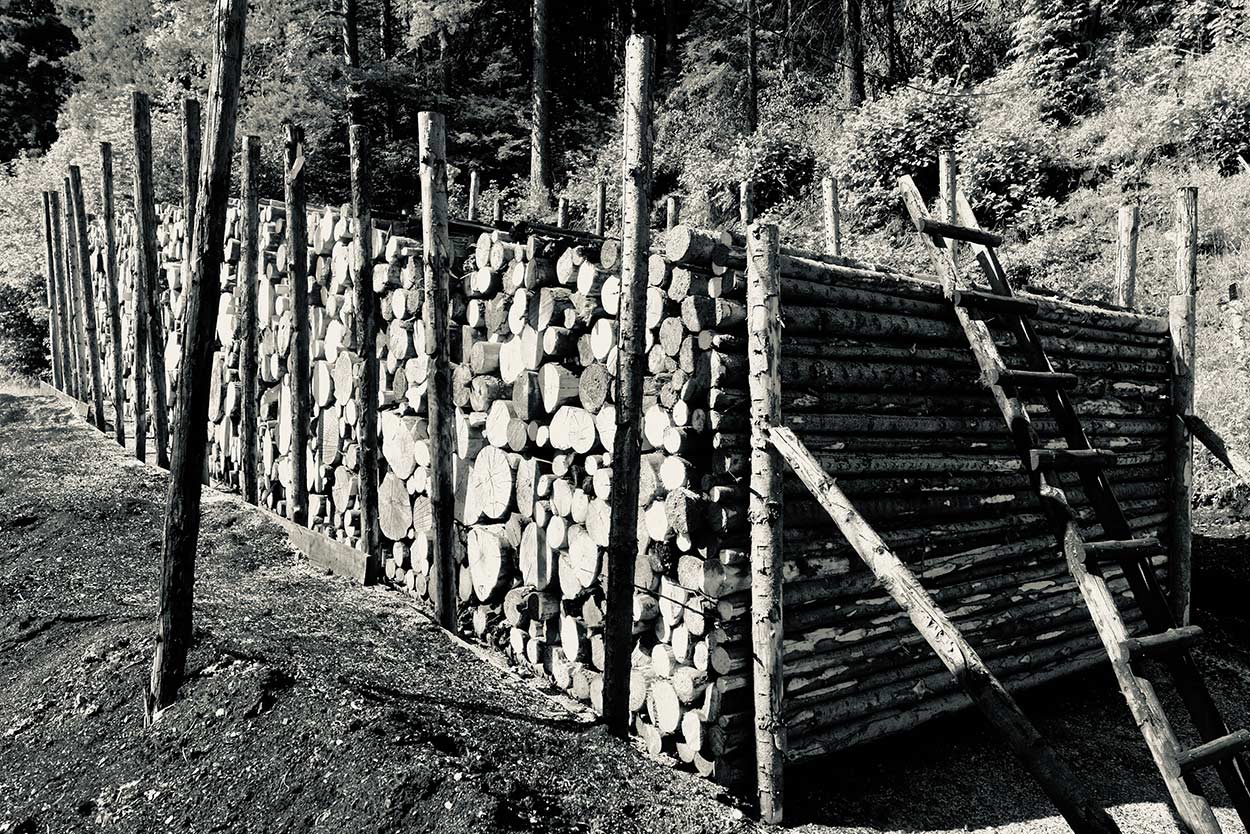
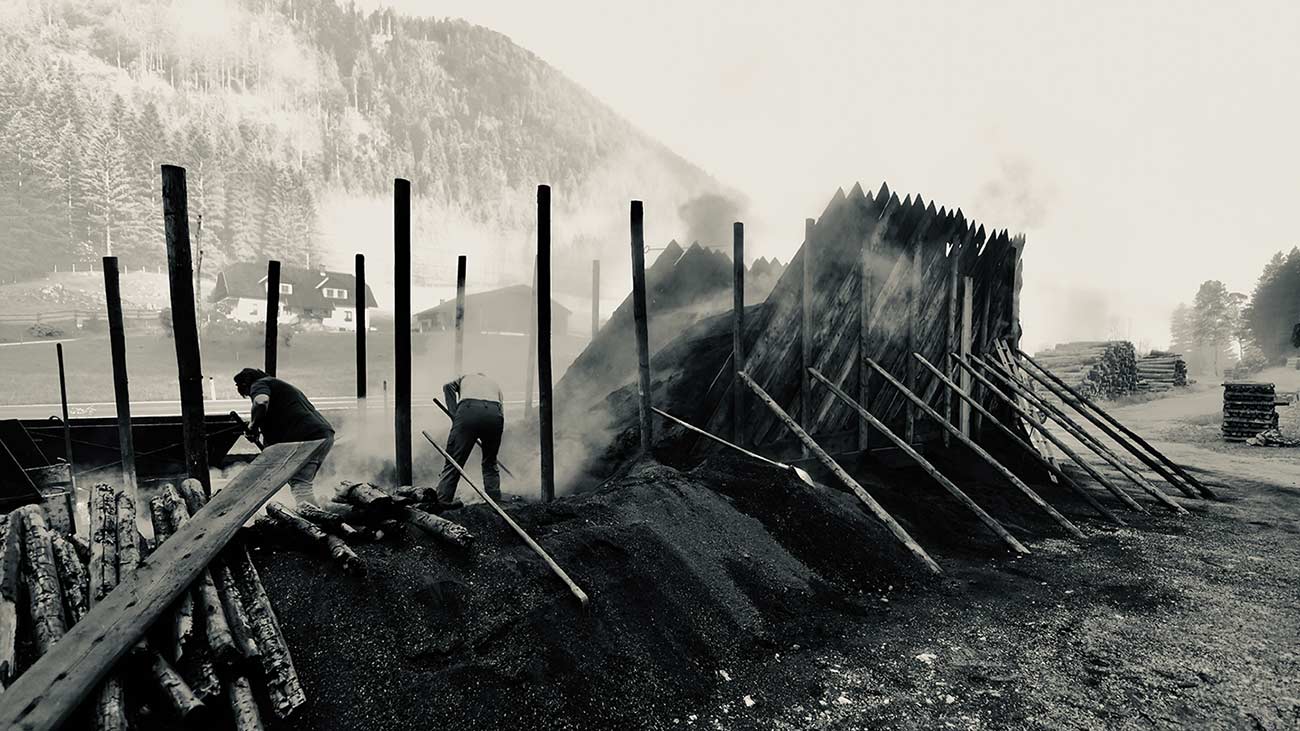
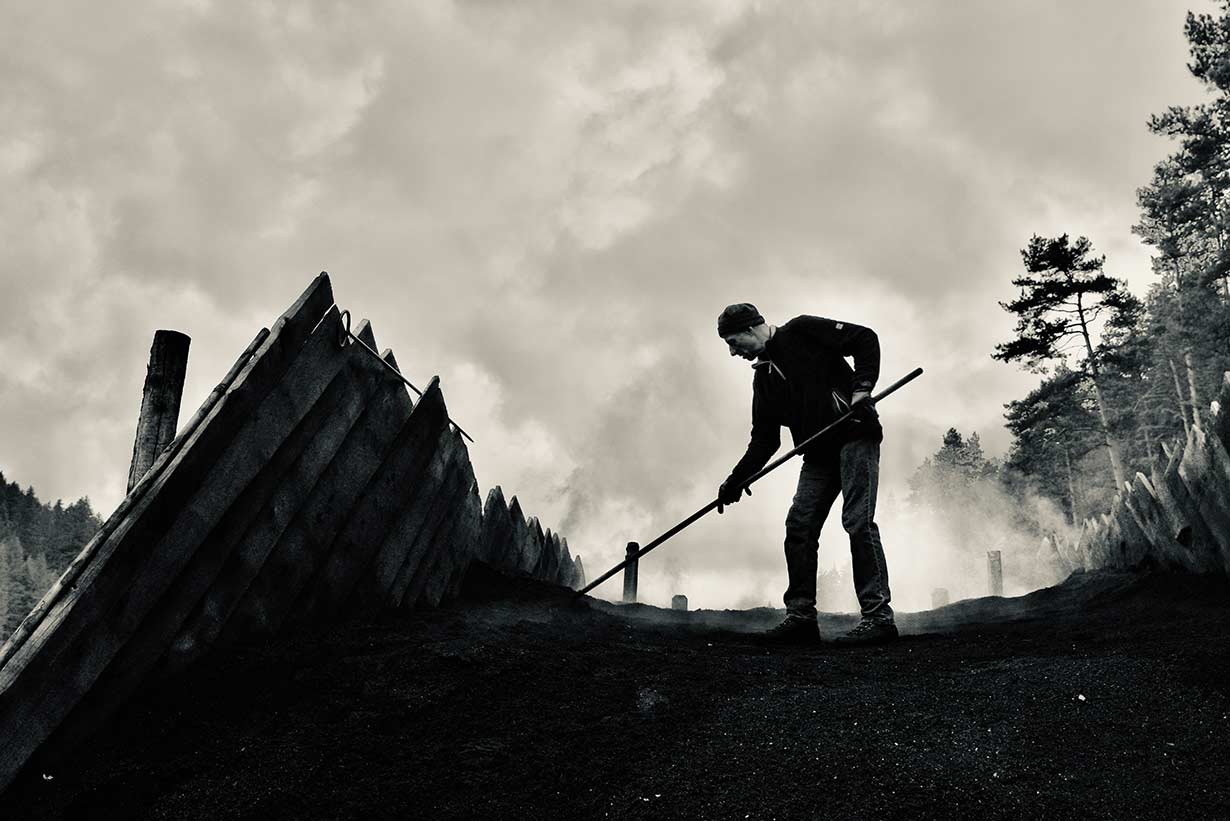
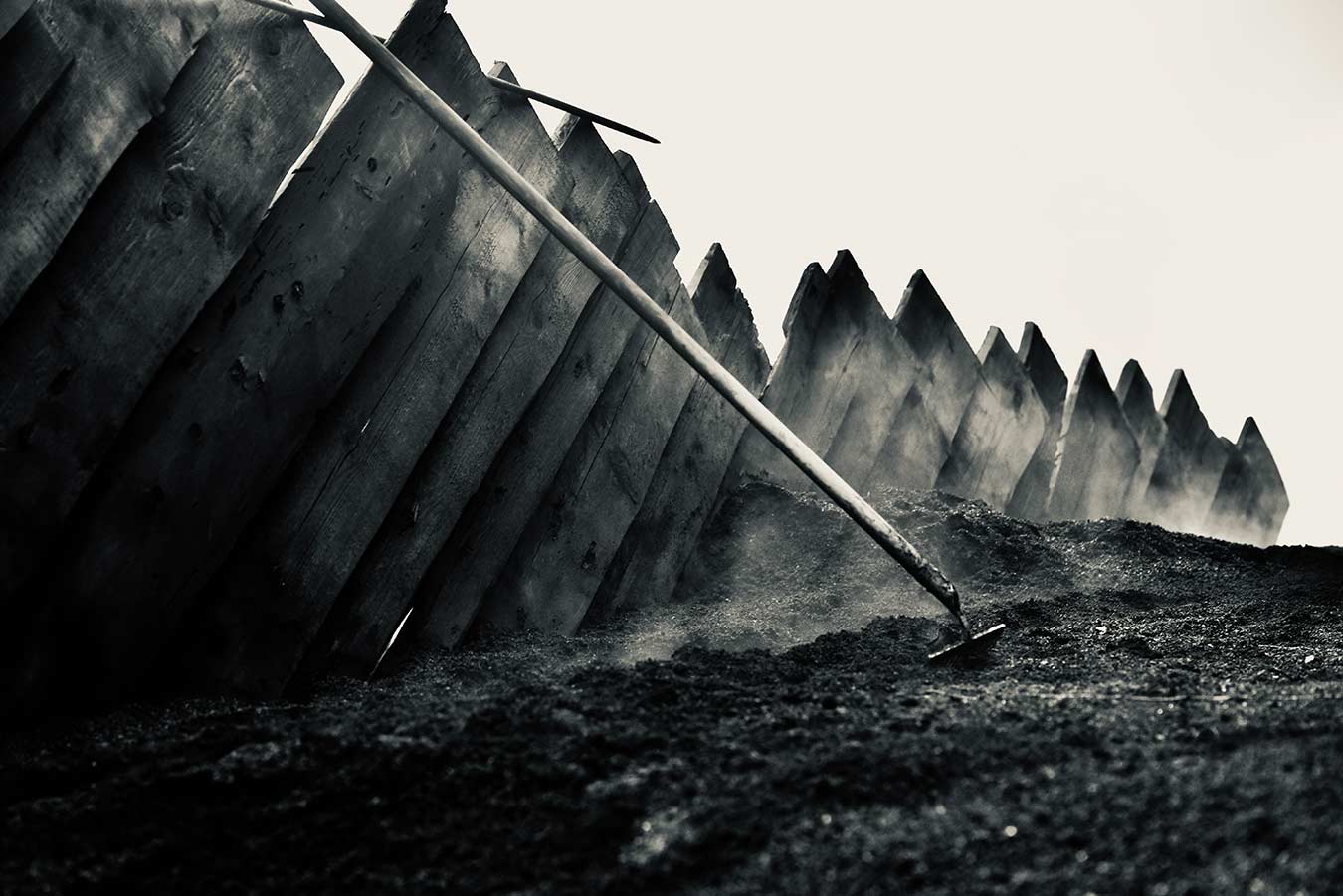
In contrast to the round charcoal kiln, in which logs approximately one meter long are stacked upright in a cone shape on two to three levels around the ignition shaft, in the long kiln thick and thin logs three meters long are stacked horizontally to form a rectangular pile measuring 1.3 by 3.5 meters and approximately 13 meters long. The amount of wood contained therein amounts to around 100 cubic meters. Like the round kiln, the long kiln is also covered with spruce brushwood before it is “blackened” by applying an insulating layer (a mixture of sand, earth, and coal dust, called ‘Lösche’ in German) up to 30 cm thick. To ensure that the insulating layer also sticks to the side walls, the kiln is enclosed on all sides with slanted boards.
The long kiln is lit at the top of its low, wide side and then smolders from front to back for about 6 weeks, allowing the charcoal burners to remove charcoal from the front of the kiln for the first time after 7-10 days, while it is still smoldering at the back.
Holger Hoffmann ©
All rights reserved.
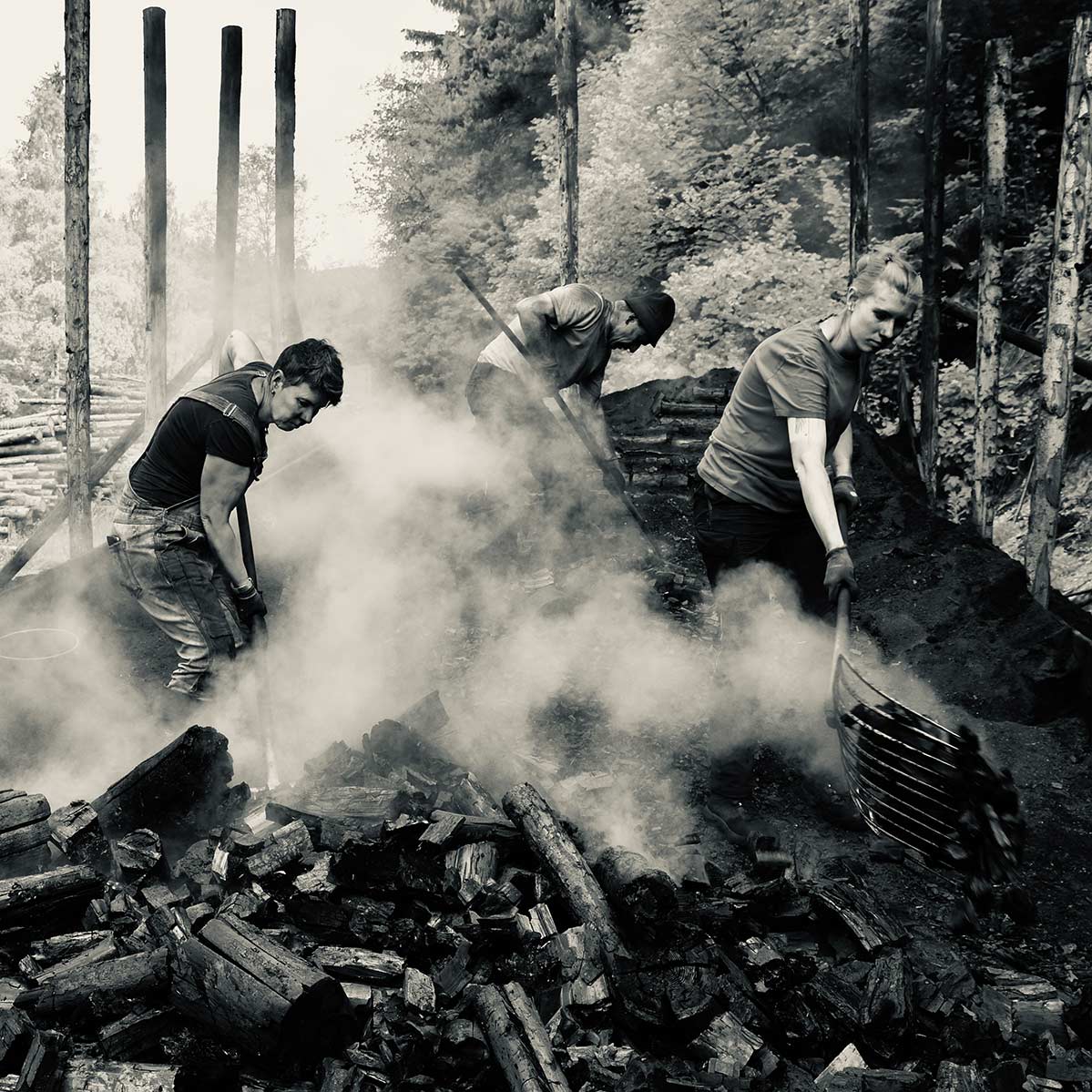
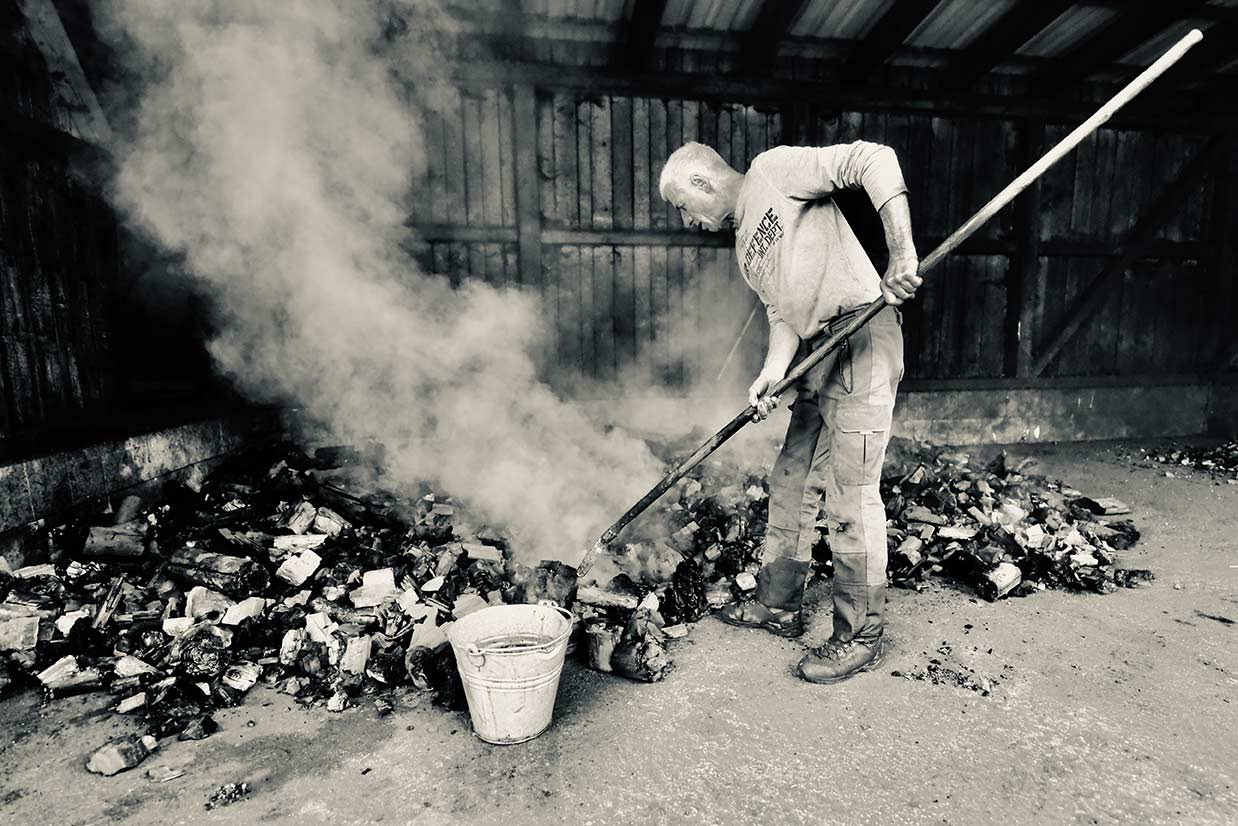
They’ve also been up since 5 a.m. and are already in their element. Today they are being helped by their 23-year-old daughter Hanna, who works as a hairdresser in the village but would like to become a farmer. Sepp has removed the insulating layer, extracted a batch of coal with the coal hook, and immediately covered the extraction spot with insulating material again. Regina and Hanna take turns pouring water over the charcoal pieces, which are still glowing inside, and dip the larger pieces into a water basin. A cloud of steam rises with a hiss and envelops them briefly.
Now the charcoal can be shoveled onto the tractor tray with the charcoal fork, then spread out on the ground.
Here, the charcoal will be monitored for at least another 24 hours to prevent any embers from flaring up. Sepp will therefore spend the next night in the charcoal burner’s hut.
Holger Hoffmann ©
All rights reserved.
The work leaves its mark; everyone—including us—now has black hands and faces. Sepp and Regina’s kiln is now completely cleared out, and the burn is finished. Sepp and Hanna immediately set about cleaning up the charcoal site. They clean it with rakes and brooms, sweeping up the ‘Lösche’ along the three sides of the charcoal bed, waiting there for the next kiln. Sepp stacks the boards from the formwork, the struts, and the inserts, collectively known as the “Kohlbschlacht” or “Kohlbsetz,” next to the charcoal site. Only the poles remain standing.
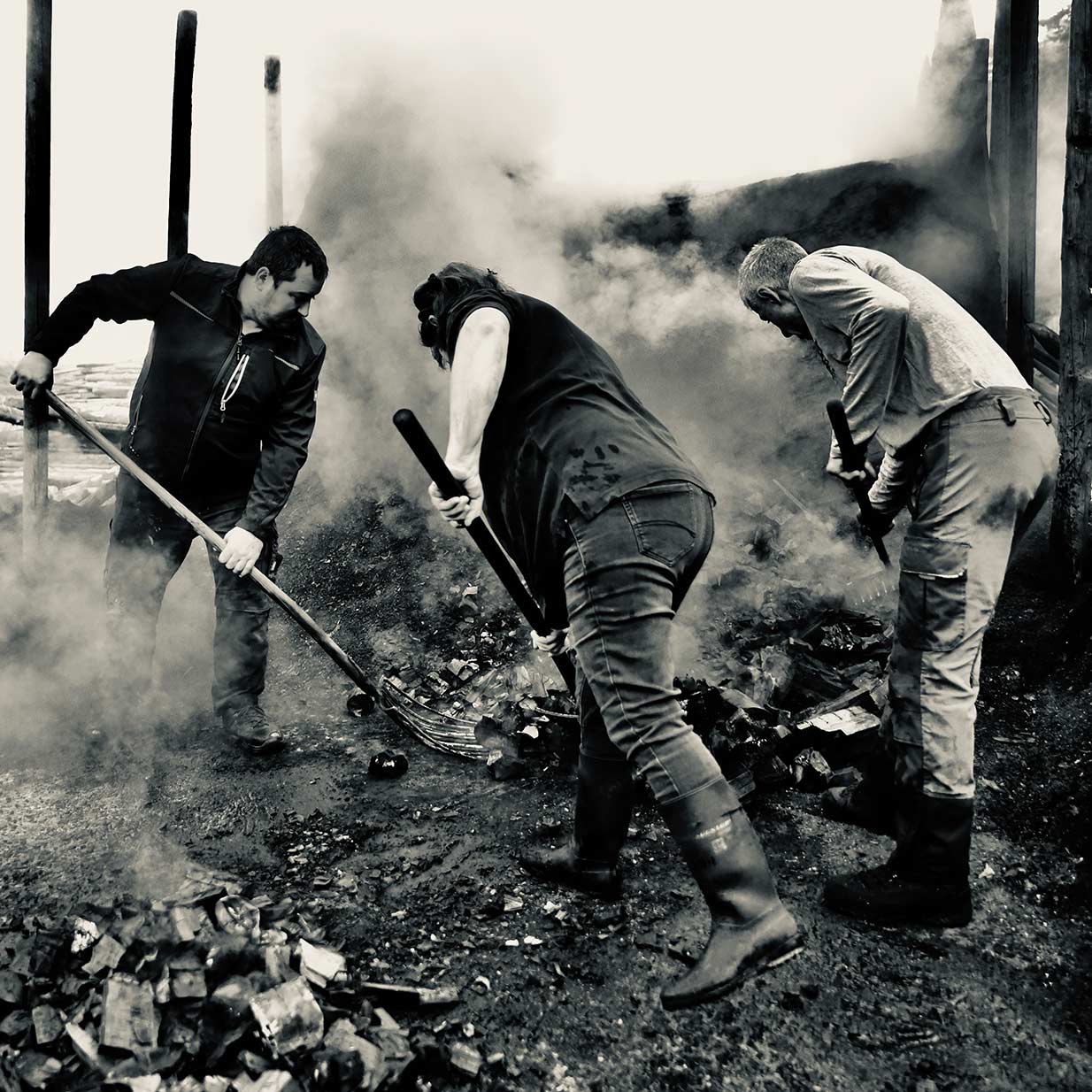
The next morning, we have the opportunity to watch Peter and Gertrud dismantling the kiln. Their eldest son, Peter, assists them and will formally take over the farm in two weeks. The kiln will not be completely burned out by then. They will keep helping as long as they can, says Peter. Their son is unmarried.
Holger Hoffmann ©
All rights reserved.
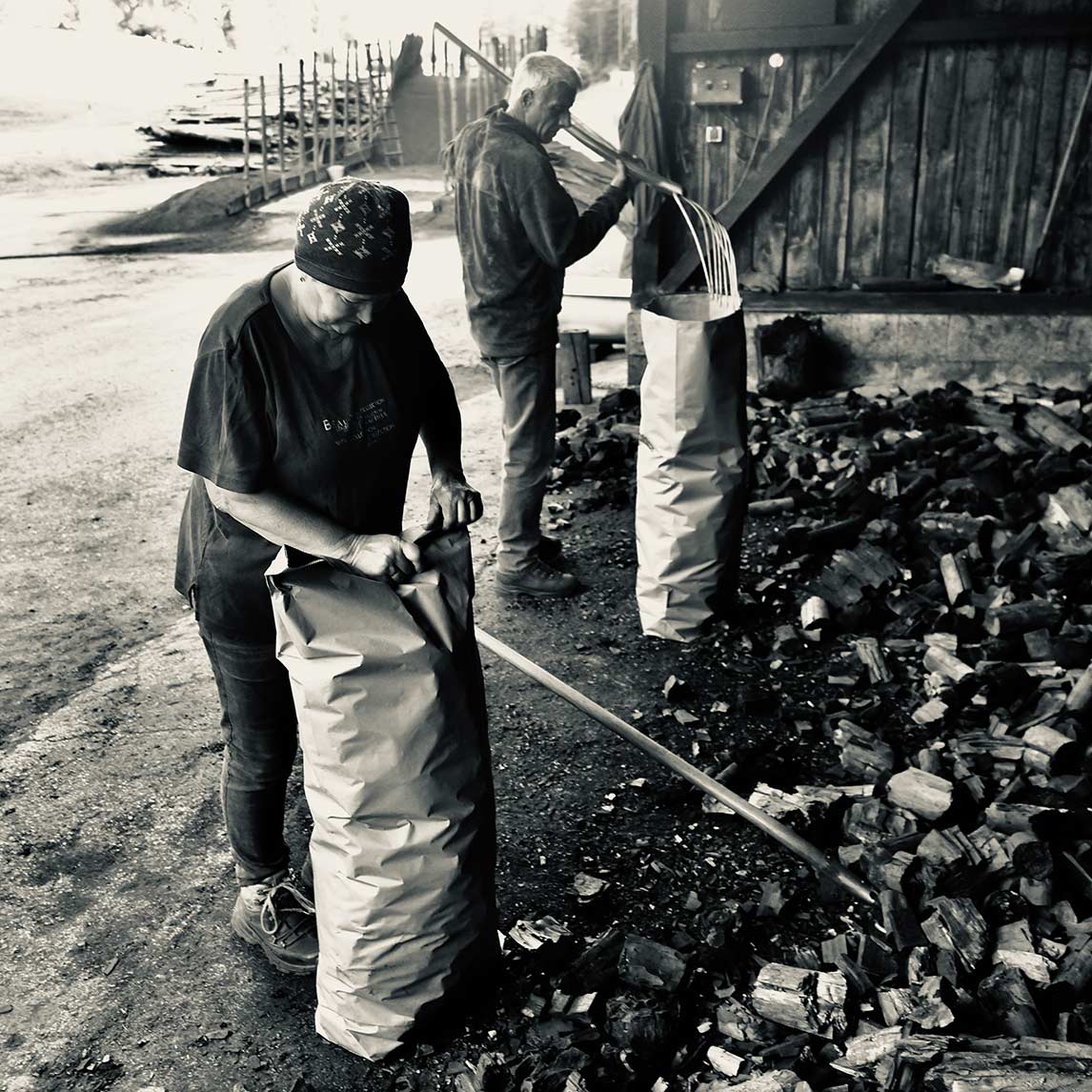
Further up, at her brother’s charcoal kiln, Regina and Hanna are already bagging the now cooled charcoal. Meanwhile, on the farm, Sepp is busy pouring hundreds of pounds of charcoal dust into the manure pit and mixing it with the manure using a tractor-mounted agitator. This has several advantages, Sepp explains: it reduces odor emissions, improves the fertilizing effect, increases the soil’s water-retention capacity, and reduces the manure’s environmental impact. He cannot sell the charcoal dust, as this would require a state organic certificate, which involves a lot of administrative effort and costs.
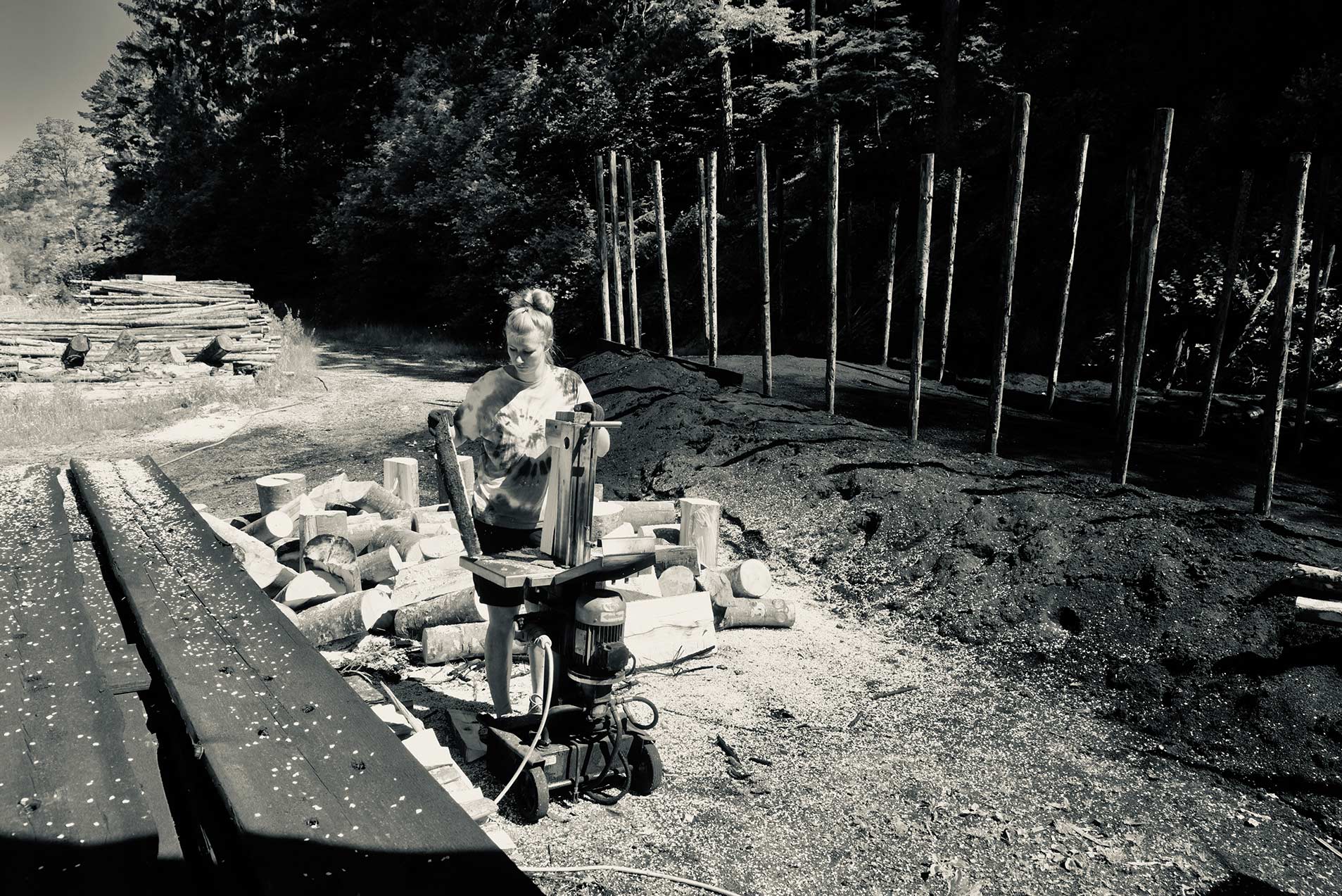
Hanna has now moved on to splitting wood. They will need these small logs when stacking the new kiln to fill the inevitable air spaces between the large logs so that as little air as possible remains in the kiln, thus promoting the smoldering process.
Holger Hoffmann ©
All rights reserved.
A week later we receive an email from Regina: “Yesterday, we started stacking a new long kiln.
So if you want to stop by again on your way back and take pictures of the ‘naked’ charcoal kiln, you are more than welcome to do so.” Of course we want to.
The ‘naked’ charcoal kiln with its imposing trunks glows in the afternoon sun. Unfortunately, we can’t wait until it is lit, because we don’t want to miss the European Charcoal Burners’ Meeting. We say goodbye the next morning. Peter and Gertrud are busy bagging charcoal. It is the last time before the farm is handed over to their son in two days. We sense a touch of melancholy in Peter.
… and if they haven’t died, the two brothers and their wives will continue to burn charcoal in Rohr in the mountains for a long time to come.
Holger Hoffmann ©
All rights reserved.
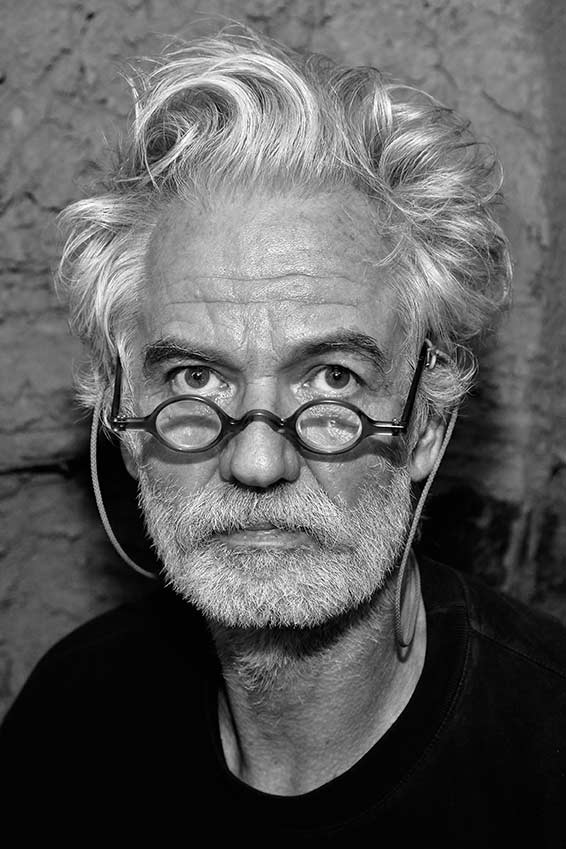
Holger Hoffmann
Holger Hoffmann ©
All rights reserved.
Right: The Charcoal Brothers and their Wives
Holger Hoffmann © All rights reserved.
Holger Hoffmann is a Swiss travel and documentary photographer. He and his wife, Sylvia Furrer, have already traveled to 110 countries. The longer they travel together, the more fascinated they become by the customs and everyday life of the indigenous people who preserve their traditional culture. They deeply respect these people, who live in remote areas under harsh conditions, such as the extreme cold of Siberia, the hot desert of the Danakil, the humid jungles of West Papua, or the high altitude of the Himalayas. Nomadic peoples have become a major focus of their recent travels.
Holger Hoffmann has published travel and photo reports in various magazines.
email: info@chaostours.ch
Visit: chaostours.ch
Instagram: @chaostours.ch
@chaostours.ch_bw